Today’s Sponsor:
While other sectors stall, AI investment is accelerating — showing up in earnings calls, corporate budgets, and real-world deployment. Capital is quietly concentrating around companies with clear demand and long-term relevance, and selective opportunities are forming right now.
A new research brief identifies 2 AI stocks trading under $15 that may be positioned for the next phase of growth — including key developments that could move these names in the months ahead.
Get the Free AI Stocks ReportBy following the link above, you're choosing to opt in to receive insightful updates from Investing Ideas Daily + 2 free bonus subscriptions! Your privacy is important to us. You can unsubscribe anytime. See our privacy policy for details.

Three reminders from the ancient world: trade leaves fingerprints, ruins hide in plain sight, and even the most celebrated monuments can be built to last — and rebuilt to prove a point.
/https://tf-cmsv2-smithsonianmag-media.s3.amazonaws.com/filer_public/87/a5/87a5bfac-08d0-4f12-906c-80d91e88be26/gettyimages-2299583059.jpeg)
Image via Smithsonian Magazine
A 4,700-Year-Old Shipwreck Off Turkey Offers a Message in Olive Oil (and Time)
Off the coast of Turkey, underwater archaeologists have found a shipwreck that may be among the oldest ever discovered. The vessel appears to date back roughly 4,700 years, and what makes the find sing is the cargo: large storage jars still holding detectable residue, likely olive oil or wine. One researcher described being stunned by how much of that ancient chemical signature remained — a rare kind of preservation that turns a broken hull into a readable document.
It’s easy to think of prehistory as isolated villages and slow change, but shipwrecks like this argue for a busier Mediterranean. If those jars once carried oil or wine, they weren’t just food; they were trade goods, status markers, and portable wealth, moving along sea routes that linked communities long before the classical world gave us names we recognize. The sea floor keeps a more honest ledger than many written sources: it records what people actually moved, what they valued, and how far they were willing to travel to get it.
Source: Smithsonian Magazine
Read the full story at Smithsonian Magazine →
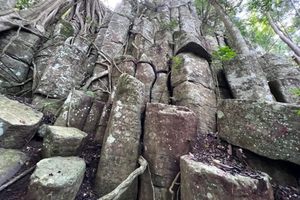
Image via Atlas Obscura
Ta Kon Citadel: When the Mountain Keeps Its Own History
Deep in the remote mountains of Vinh Son, Vietnam, Ta Kon Citadel emerges from the greenery like a half-remembered story — massive stonework that can look, at first glance, like the remains of a colossal fortress swallowed by jungle. Atlas Obscura’s description captures that particular feeling certain ruins give: the sense that the landscape didn’t just surround human ambition, it patiently reclaimed it.
Citadels are rarely only military structures. They are statements about who is in charge, what territory matters, and where protection ends and vulnerability begins. In places as rugged as Vinh Son, a stronghold also becomes a negotiation with geography: mountains that can shield a community can also isolate it, and dense terrain can preserve history precisely because it makes the past hard to reach. Ta Kon invites the kind of curiosity that textbooks often skip — the local, layered histories that don’t always fit neatly into a single national narrative.
Source: Atlas Obscura
Read the full story at Atlas Obscura →

Image via HistoryExtra
A Seven-Wonder Temple That Kept Getting Destroyed (and Rebuilt)
One of the Seven Wonders of the Ancient World stood in what is now Turkey: a gleaming white marble temple, older and larger than the Parthenon, influential enough to shape the look of Greek temples that came after it. Yet its story isn’t a serene tale of timeless beauty. According to HistoryExtra, the monument was destroyed three separate times — a reminder that fame never guaranteed safety, and that sacred spaces often sit at the crossroads of politics, rivalry, and catastrophe.
Repeated destruction points to a pattern as old as urban life: the most visible symbols attract both devotion and violence. Temples weren’t just houses of worship; they were treasuries, civic pride made stone, and public declarations of identity. When they fell, it was sometimes accident, sometimes opportunism, sometimes a deliberate attempt to erase or reframe what a community stood for. And when they were rebuilt, it wasn’t merely restoration — it was a choice to keep telling the same story about power, piety, and permanence, even when history kept interrupting.
Source: HistoryExtra
Read the full story at HistoryExtra →
That’s it for today’s Time Capsule. If you catch yourself thinking “people back then were simpler,” remember: they traded across seas, built fortresses into mountains, and argued over monuments so fiercely they kept tearing them down. See you tomorrow with another pocket of the past.
— Time Capsule Editorial