Today’s Sponsor:
Trump's Department of Labor just proposed allowing physical gold inside 401(k)s — and if approved, millions of Americans could gain access by 2027. BlackRock is already launching new gold funds. JP Morgan forecasts gold hitting $6,000/oz. And gold has already surged 64% in 2025 — before this policy even officially dropped.
If you're over 59½, there's a legal, IRS-approved strategy to move part of your 401(k) or IRA into physical gold right now — tax-deferred and penalty-free. A free guide called "Retirement to Gold" breaks down exactly how to do it before everyone else catches on.
Get the Free Guide NowThis is an advertisement. If you no longer wish to receive promotional messages from Secco Squared, please unsubscribe here. Or write to: 351 Paseo Nuevo, Floor 2, Santa Barbara, CA, US 93101.

Friday, October 23, 2026 | Historic Tales They Didn’t Teach You in School. Today we’re following three different trails into the Norse and medieval world—one in a Norwegian coin hoard, one in a German palace site, and one in a mythic realm that pop culture keeps getting slightly wrong.
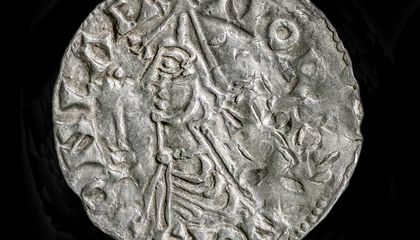
Image via Smithsonian Magazine
A 5,500-Coin Viking Hoard Yields One That Feels Like It Came Straight From the King’s Hand
Archaeologists in Norway have been working through a hoard of roughly 5,500 Viking Age coins, but it’s one particular piece that’s stealing the spotlight: a coin minted under King Olaf II Haraldsson, so rare that fewer than 20 examples have ever been found. Researchers are already calling it a national treasure—not because it’s shiny for a museum case, but because it’s a direct, tangible handshake with a ruler who sits at the crossroads of politics, religion, and identity in medieval Norway.
Coins are deceptively small historical documents. They carry names, symbols, and claims of legitimacy, all pressed into metal meant to circulate hand-to-hand. In the Viking world especially, coin finds can map trade networks, shifting power centers, and the slow tightening of royal authority over regions that weren’t always eager to be ruled. Olaf II’s reign (and posthumous sainthood) became part of Norway’s long story about becoming a kingdom with shared institutions, shared faith, and eventually shared memory. It’s hard not to hear that in the quote from one researcher who said they could almost imagine Olaf himself holding the coin—because that’s what artifacts do at their best: they collapse the distance between then and now.
There’s also a bigger lesson in the hoard itself. A cache of coins can signal fear, instability, or a practical attempt to store wealth in a world without banks. Buried money often marks a moment when someone believed the future was uncertain but still expected to come back. Most never did. Every time archaeologists open one of these time-locked savings accounts, we get a snapshot of what value looked like in a society balancing raiding and trading, local loyalties and emerging kingship, old beliefs and new institutions.
Source: Smithsonian Magazine
Read the full story at Smithsonian Magazine →
Germany’s Lost Royal Palace of Helfta Offers Up a 10th-Century Surprise From Otto the Great’s World
Archaeologists excavating the site of the lost medieval royal palace of Helfta in Germany have uncovered a 10th-century stone building, an important clue in reconstructing how power actually operated in the age of Otto the Great. When we imagine medieval rulership, we tend to picture fixed capitals and permanent courts. Otto’s reality was often more mobile: rulers traveled with households and administrators, projecting authority by showing up, holding assemblies, dispensing justice, and reminding elites who sat at the center.
That’s why palace sites like Helfta matter. They weren’t just luxurious residences; they were political infrastructure. A newly identified stone structure can help answer grounded questions historians argue about all the time: How were these complexes laid out? Which spaces were ceremonial, which were administrative, which were practical? Even the choice to build in stone is a message, hinting at resources, ambition, and a desire for durability—a physical assertion that this rule was meant to last.
Otto the Great’s 10th-century reign is often taught as a high-level story about empires and coronations, but digs like this pull the lens down to lived governance. They show how legitimacy wasn’t just proclaimed; it was housed, staged, fed, maintained, repaired, and managed through places like Helfta. When archaeologists find walls, foundations, and building traces, they’re also finding the everyday machinery of authority.
Source: Medievalists.net
Read the full story at Medievalists.net →

Image via All That’s Interesting
Helheim, Reconsidered: The Norse Underworld Wasn’t Simply a Place of Punishment
Helheim shows up in modern retellings as a kind of Norse hellscape, but the older idea is more nuanced—and in some ways more human. In Norse mythology, Helheim is the chilly underworld ruled by the goddess Hel, yet it isn’t automatically framed as a torture chamber for the wicked. Instead, it’s often described as a continuation of existence for many of the dead: a place where people still eat, drink, sleep, and carry on in a shadowed version of life.
That distinction matters because it reminds us that not every culture sorted the afterlife into tidy moral categories of reward and punishment. The Norse cosmos made room for different destinations shaped by circumstance, fate, and the kind of death one met. Helheim could be bleak, yes, but bleakness isn’t the same thing as condemnation. A cold landscape can be about distance from the living, or the inevitability of winter, or the sober recognition that life ends—not necessarily about cosmic courtroom verdicts.
It’s also a good example of how later storytelling reshapes earlier belief. As Christianity spread across Scandinavia, old concepts were sometimes reinterpreted through newer moral frameworks, and centuries after that, popular culture stacked on its own layers. Reading Helheim on its own terms is like restoring an old painting: the scene changes when you remove the varnish of assumptions. The underworld becomes less of a jump scare and more of a window into how the Norse imagined fate, memory, and the long quiet after the feast.
Source: All That’s Interesting
Read the full story at All That’s Interesting →
That’s the capsule for today. If you had to choose: would you rather hold a king’s coin, walk through a newly uncovered palace room, or hear a myth explained the way its first audience might have understood it? See you next time, with more history hiding in plain sight.
— Time Capsule Editorial