Today’s Sponsor:
Market sectors are quietly shifting. While some previously hot areas slow down, overlooked sectors from late last year are showing renewed activity through subtle changes in participation and volume patterns.
Our new Early-Year Market Activity Report reveals developing signals, a simple filtering framework, and specific sectors gaining momentum before broader attention follows. These early transitions often happen quietly at first.
Get the Free Report*We encourage readers to perform their own research and due diligence on any information we provide. By clicking the link you will automatically be subscribed to the Market Pulse Today Newsletter. Privacy Policy

From Irish hell-raisers to Biblical towers to the chess match that shaped empires — history's most ambitious projects reveal what happens when power meets hubris.

Image via Atlas Obscura
Ireland's Hellfire Club: Where Georgian Elites Went to Misbehave
Perched atop Montpelier Hill in Rathfarnham, Dublin, stand the eerie stone ruins of what locals still call the Hellfire Club. Built in 1725 for William Connolly, then Speaker of the Irish House of Commons and reportedly the wealthiest man in Ireland, the hunting lodge was constructed with stones plundered from an ancient cairn. Legend has it that desecrating the prehistoric burial site brought a curse — the roof blew off in a storm shortly after completion.
But the building's real infamy came later, when it became the meeting place for the Irish Hellfire Club, a society of wealthy rakes and aristocrats who gathered for drinking, gambling, and activities that scandalized even Georgian-era Dublin. Tales of devil worship, black masses, and debauchery swirled around the mountaintop meetings, though historians suggest the reality was likely more mundane: privileged men behaving badly while common folk invented darker explanations for their secretive gatherings. The ruins remain a Dublin landmark, a stone reminder that the rich have always had their exclusive clubs — and that the public has always been fascinated by what happens behind closed doors.
Read the full story at Atlas Obscura →
Did the Tower of Babel Really Exist? Meet Etemenanki, the Ziggurat That Touched the Clouds
The Biblical story of the Tower of Babel — humanity united in building a structure to reach heaven, only to be scattered by God into different languages — has captivated imaginations for millennia. Now National Geographic explores the leading archaeological candidate for inspiration behind the tale: Etemenanki, a massive ziggurat in ancient Babylon that stood approximately 300 feet tall and dominated the skyline of what is now Iraq.
Built and rebuilt over centuries, with its most famous iteration constructed under Nebuchadnezzar II around 600 BCE, Etemenanki was a temple dedicated to Marduk, Babylon's patron god. Ancient texts describe its seven terraced levels rising toward the heavens, visible for miles across the Mesopotamian plain. When Hebrew exiles lived in Babylon during the 6th century BCE captivity, they would have witnessed this architectural marvel firsthand — a monument to imperial power and religious devotion that dwarfed anything in their homeland.
The ziggurat was eventually destroyed, its baked bricks carted away for other construction projects, leaving only foundation traces for modern archaeologists. But its cultural echo persists. Whether the Genesis account drew directly from Etemenanki or from the broader Mesopotamian tradition of temple-towers, the story it tells remains resonant: a warning about human ambition, the fragility of unified purpose, and the observation that our greatest monuments eventually return to dust.
Read the full story at National Geographic →
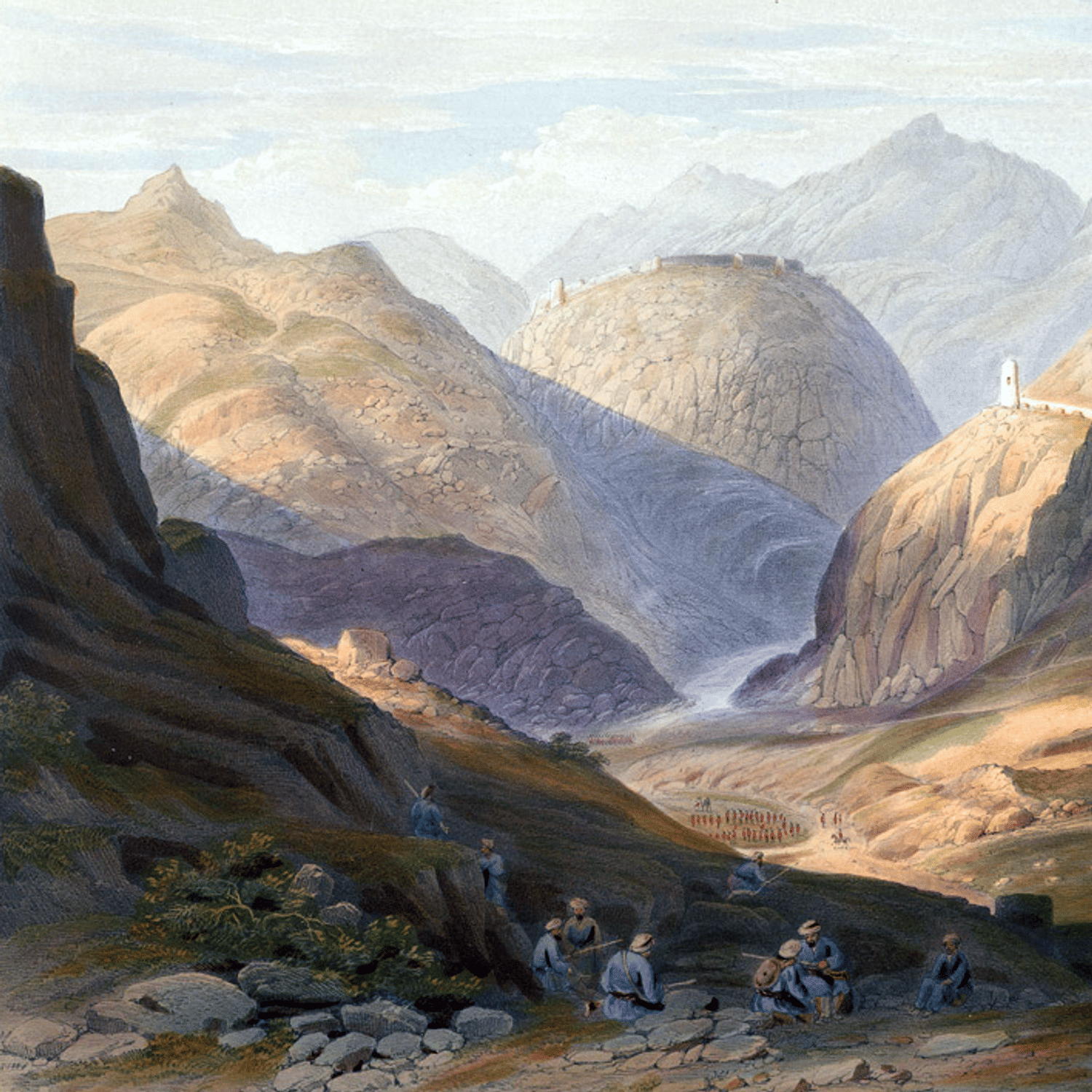
Image via World History Encyclopedia
The Great Game: When Britain and Russia Played Chess with Central Asia
Long before the Cold War, there was another geopolitical rivalry that defined a century: The Great Game, the 19th-century strategic competition between the British and Russian empires for influence across Central Asia. The term itself was coined by Arthur Connolly, a British intelligence officer and explorer who would eventually be executed in Bukhara in 1842, but it gained literary immortality through Rudyard Kipling's 1901 novel Kim, which romanticized the shadow war of spies, explorers, and political agents playing out across the peaks and deserts between India and Russia.
The stakes were real enough. As Russian expansion pushed southward through the Caucasus and into Central Asia throughout the 1800s, British officials in India grew increasingly paranoid about a potential invasion through Afghanistan. This fear drove decades of interventions, surveying expeditions disguised as exploration, puppet governments, and two disastrous Anglo-Afghan wars. Meanwhile, Russian officers pushed into Turkestan, securing Tashkent, Samarkand, and Bukhara, while both empires mapped territories, recruited local allies, and engaged in the 19th-century version of intelligence gathering.
The Great Game never erupted into direct war between the empires, but its effects shaped the modern map of Central Asia. The buffer states, arbitrary borders, and diplomatic agreements meant to prevent conflict created artificial boundaries that still cause tension today. Afghanistan's strategic importance, Pakistan's northwest frontier, and the contested borders of the 'stans all bear the fingerprints of officers and diplomats who saw the region as a chessboard. The game may have ended officially with the Anglo-Russian Convention of 1907, but the board they played on remains.
Read the full story at World History Encyclopedia →
Stay curious about the ruins we leave behind — they're usually more honest than the monuments we intend.
— Time Capsule Editorial