Today’s Sponsor:
The AI revolution is here—and I've identified 9 powerhouse companies with real US operations, proven revenue growth, and deep AI integration that are primed to dominate. From a hidden chip maker set to power domestic AI manufacturing to a cloud provider ready for explosive growth, these aren't the tired "AI hype" stocks everyone's talking about.
The smart money is already watching, and once they move, these stocks could soar. Don't be the last to catch this wave—get the complete details on all 9 game-changing companies in my FREE report before opportunity passes you by.
Get the Free ReportBy clicking this link you agree to receive emails from StockEarnings and our affiliates. You can opt out at any time. Privacy Policy.

Historic Tales They Didn’t Teach You in School: a buried philosophy finally speaks, World War II in rare frames, and the rowdy Venetian tradition of settling scores on bridges.
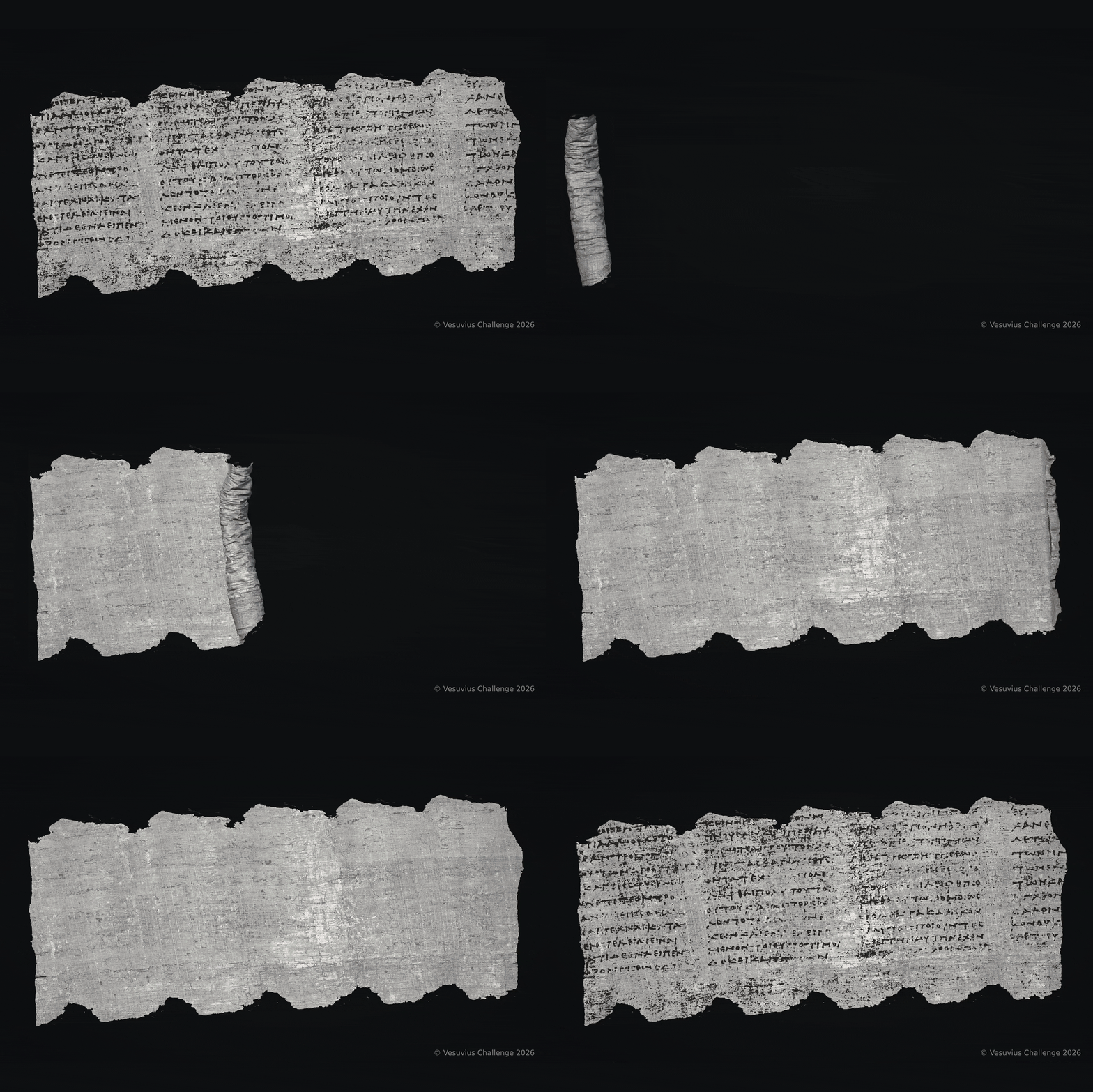
Image via Smithsonian Magazine
Vesuvius Didn’t Just Bury a City — It Sealed a Library, and We’re Finally Reading It
Nearly 2,000 years after Mount Vesuvius entombed Herculaneum in 79 CE, scientists have deciphered surviving fragments of a philosophical treatise preserved in the eruption’s aftermath. The text comes from carbonized papyrus scrolls—part of a famed ancient library—so fragile that for centuries the act of opening them could destroy them. Now, with modern imaging and decoding techniques, passages that once looked like little more than burnt bark are becoming readable again.
What’s emerging isn’t just a curiosity for classicists; it’s an unusually intimate snapshot of how educated Romans and Greeks argued about the hardest human questions. The newly accessible sections reportedly grapple with ethics, knowledge, and human nature—topics that feel timeless precisely because every era thinks it’s inventing them. Historically, this is a reminder that disasters don’t only erase: sometimes they preserve, creating time capsules that outlast the civilizations that made them. Vesuvius froze a moment of intellectual life in place, and today’s tools are turning that freeze-frame back into a conversation.
There’s a long precedent here: ancient texts often survive by accident—sealed in jars, copied by monks, stashed in desert caves, or, in this case, baked and buried by volcanic ash. Each recovery reshapes our sense of the past, not with grand monuments, but with everyday arguments about what it means to live well.
Read the full story at Smithsonian Magazine →

Image via All That's Interesting
World War II, Seen Up Close: Rare Photos That Complicate the Official Story
A new collection of rarely seen World War II photographs offers a bracing reminder that the deadliest war in human history was experienced not as a tidy timeline of battles, but as millions of private, chaotic moments. The images span front-line conditions, civilian life under bombardment, and the war’s culminating terrors—including the atomic bombings of Hiroshima and Nagasaki. Even when you think you “know” this history, photographs have a way of reintroducing it as lived reality.
Historically, World War II is also the moment when visual documentation becomes inseparable from the story itself. Cameras were everywhere compared to earlier wars, and governments understood images as tools—of morale, persuasion, and memory. That means every wartime photo sits at the intersection of witness and message: some were candid, some curated, many both. The value of a collection like this is not just what it shows, but what it prompts us to ask: Who is behind the lens? Who is missing from the frame? What did editors want the public to feel when they saw it?
The deeper lesson is how quickly extraordinary circumstances become routine. In photo after photo, people adapt—improvising meals, rebuilding streets, waiting in lines, writing letters, carrying on. It’s a visual archive of endurance, yes, but also of the staggering human cost embedded in “total war,” where battlefront and homefront blur into one.
Read the full story at All That's Interesting →
When Venice Settled Scores on Bridges (and Artists Made It a Genre)
Long before Venice became the postcard version of itself, it had a rougher civic tradition: organized brawls on bridges, commemorated in art from the 17th and 18th centuries. The Public Domain Review gathers images from an era when these “bridge fights” weren’t merely random street violence but a recognizable social practice—so familiar that artists could depict it as a scene with its own visual language.
To modern eyes, the idea is almost unbelievable: a city built on water, dependent on narrow crossings, turning bridges into stages for ritualized conflict. But historically it makes a strange kind of sense. Early modern European cities often channeled public aggression into regulated forms—festivals, contests, charivaris, and other customs that mixed entertainment with social control. Venice’s bridge brawls suggest a community negotiating honor, neighborhood identity, and masculine reputation in public, in a place where space was limited and visibility was unavoidable.
What makes the artwork especially valuable is that it captures more than fists and chaos. It preserves the crowd dynamics, the architecture, the sense of spectatorship—how violence can become civic theater when a culture normalizes it. These scenes are a reminder that “public order” has always been something societies actively construct, sometimes by permitting just enough disorder to keep the peace the rest of the time.
Read the full story at The Public Domain Review →
That’s the capsule for today—three reminders that history isn’t just dates and battles, but preserved voices, stubborn images, and the odd customs people once treated as normal. See you tomorrow.
— Time Capsule Editorial