Today’s Sponsor:
Elon Musk got full access to every federal budget, every agency, every line item — and what he found should terrify every American with savings. The U.S. spends $1 trillion a year on interest alone, 70% of the budget is legally untouchable, and even firing every federal employee wouldn't close the gap. Gold is already responding — up 95% in a year to $5,150. The math is broken, and no one in Washington is going to fix it.
We've put together a free report — "Breaking Point: Musk" — revealing exactly what Musk uncovered, why it's unfixable through normal means, and the one move retirees are making right now to protect themselves. If Musk couldn't fix it, your financial plan shouldn't depend on someone else fixing it either.
Download Your Free Report NowThis is an advertisement from American Alternative Assets. © American Alternative Assets. All rights reserved. If you no longer wish to receive promotions, please unsubscribe here or write to: 21550 W Oxnard St Ste 845, Woodland Hills, California 91367.

Friday, October 30, 2026. Three dispatches from the past hiding in plain sight: a lonely Champa tower above Vietnamese fields, the marigolds that light the way during Día de los Muertos, and a newly uncovered Roman sarcophagus in Romania that makes history feel uncomfortably close.
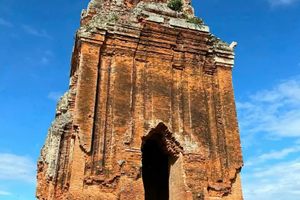
Image via Atlas Obscura
A Champa Temple Keeping Watch Over Vietnam’s Farmland
Rising above the flat agricultural landscape of An Nhon Bac, Vietnam, the Phu Loc Champa Temple reads like a punctuation mark from another century: a solitary tower on a hilltop, quiet but unmistakably intentional. Places like this can feel almost out of time, not because they’re frozen, but because the world around them keeps changing while they stay put. The effect is powerful: one structure, one skyline, and suddenly the countryside turns into a historical map.
The temple is a reminder of the Champa civilizations that once flourished along Vietnam’s central and southern coasts, deeply connected to maritime trade routes and to religious and artistic currents moving through South and Southeast Asia. Cham towers were often built of brick with sophisticated techniques that still puzzle modern observers, and they served spiritual purposes as much as political ones, signaling presence, devotion, and authority. Seeing a lone Champa tower today also invites a broader American-history parallel: how we tend to remember empires and nations as neat chapters, when the real story is messier—cultures overlapping, borders shifting, identities persisting long after capitals fall.
Source: Atlas Obscura
Read the full story at Atlas Obscura →

Image via Mental Floss
Why Marigolds Lead the Way on Día de los Muertos
If you’ve ever seen Día de los Muertos altars glowing with orange, you’ve met the marigold in its starring role. Mental Floss traces how these flowers, with their saturated color and unmistakable scent, became woven into the holiday’s traditions—both practical and symbolic. It’s one of those customs that looks purely decorative from a distance, until you learn it’s designed to do something: guide, welcome, and connect.
Across generations, marigolds have come to represent a kind of bridge between the living and the dead. Their color echoes the sun, their petals become pathways, and their fragrance is often described as a beacon—something that helps spirits find their way back to the people who remember them. There’s a deep historical pattern here that shows up across cultures (including early America): when communities confront death not as a single moment but as an ongoing relationship, they build rituals that use the senses—light, smell, food, flowers—to make memory physical. In that sense, marigolds are less “decoration” than technology of remembrance.
Source: Mental Floss
Read the full story at Mental Floss →
An Intact Roman Child’s Sarcophagus Emerges in Romania
Archaeologists in Constanța, Romania, have uncovered an intact Roman sarcophagus in a necropolis—and the fact that it belonged to a child makes the discovery especially arresting. Finds like this don’t just add detail to a textbook timeline; they reintroduce individuality into ancient history. A sarcophagus is an object built for permanence, and when one reappears intact, it’s as if the past successfully delivered a message it sealed long ago.
Constanța sits on the Black Sea, in a region shaped by Roman expansion and the trading networks that tied frontier provinces to the empire’s core. A necropolis discovery hints at the everyday realities of Roman provincial life: families investing in burial practices, communities organizing space for the dead, and local identities blending with imperial customs. Americans sometimes imagine Rome mainly as marble monuments and emperors, but the empire was also a web of port cities, migrants, soldiers, merchants, and children whose lives ended too soon. The archaeology forces the point: history isn’t only what societies built, it’s what they grieved.
Source: Archaeology Magazine
Read the full story at Archaeology Magazine →
That’s it for today’s Time Capsule. If you noticed a theme, it’s this: people have always built paths back to what they feared losing—through towers, flowers, and stone meant to outlast a lifetime. See you next issue.
— Time Capsule Editorial