One warehouse robotics company is sitting on a $22.7 billion order backlog — contracts signed, revenue incoming — and its stock is down 16.6% in the past month. That disconnect is exactly the kind of setup worth paying attention to. Heading into 2026, analysts screened the entire robotics sector and found 7 stocks with compelling cases: a pure-play warehouse name with $2B cash and zero debt, a semiconductor robotics firm that nearly doubled quarterly revenue year-over-year, and a robotic surgery company placing hundreds of next-gen systems while trading 31% below its 52-week high.
Every name and the full case behind it is available in a free report — no forms, no friction. Backlogs that size take time to convert, which means the window to understand these setups is open right now. Don't wait.
Get Your Free Robotics ReportBy clicking this link you agree to receive emails from TradingTips and our affiliates. You can opt out at any time. — Privacy Policy

Three windows into how power travels: through trade routes, through buildings that quietly preserve older worlds, and through art that can double as a moral receipt.
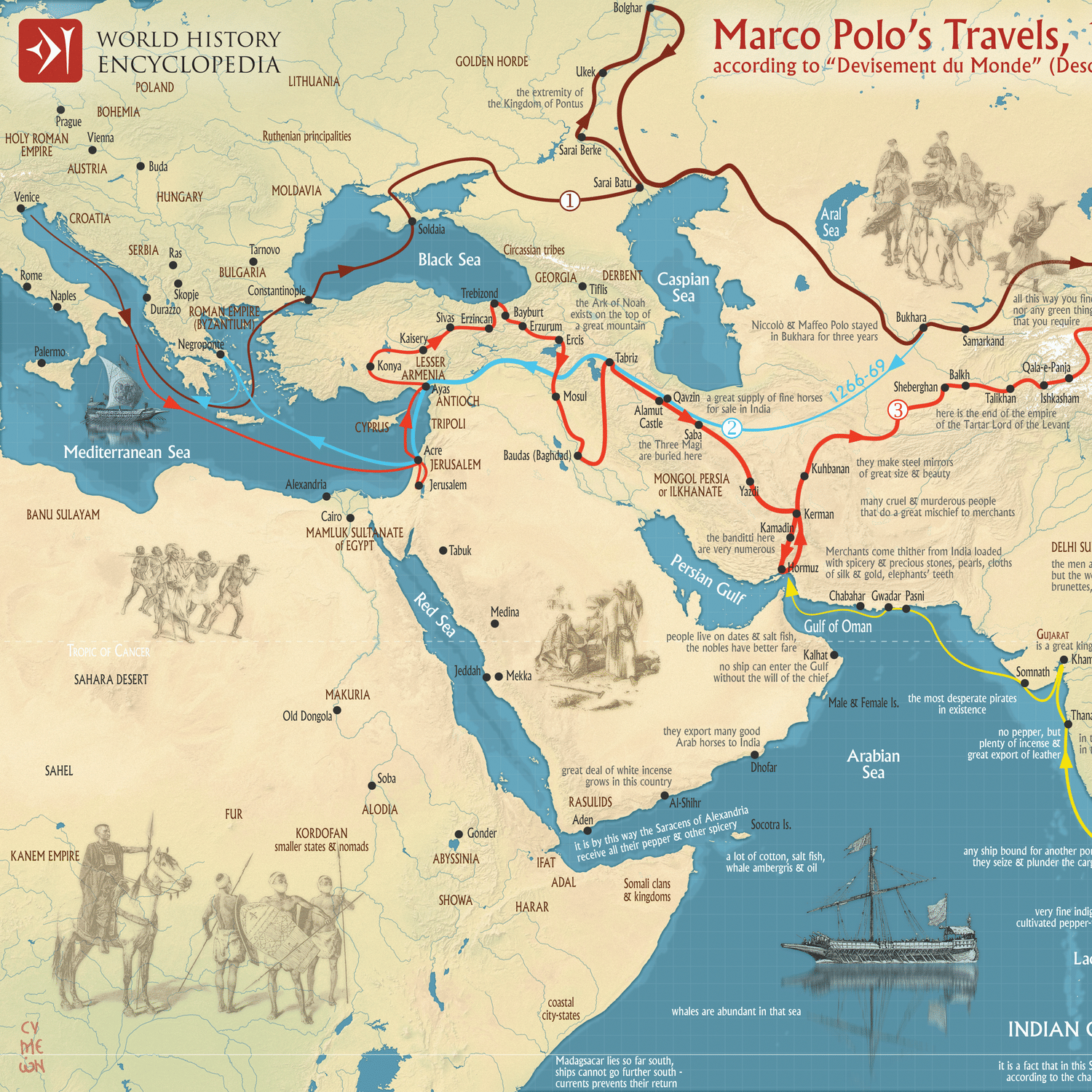
Image via World History Encyclopedia
Before the "West" Was the Center: A Tour of the Global Tapestry (1200–1450)
If you ever felt like world history jumps from "ancient" straight to "Europe," Unit 1 of AP World History: Modern is the antidote. The Global Tapestry (c. 1200–1450) is a snapshot of major regional powers and cultural systems before the Atlantic world rearranged the map. Think Song China’s sophisticated bureaucracy and economy, the Islamic world’s connected cities and scholarship, South and Southeast Asia’s maritime networks, the trading states of Africa, and Europe’s patchwork of kingdoms tied together by Christianity and feudal structures.
What makes this period feel surprisingly present is how clearly it shows the tools states use to hold themselves together: belief systems that legitimize authority, administrative systems that collect taxes and enforce law, and trade networks that move not just goods but ideas. The collection at World History Encyclopedia gathers definitions, maps, and articles that let you zoom out and then zoom in again, which is exactly how history starts to feel real: you see how a local decision fits into a wider web.
There’s also a quiet lesson here about "beginnings." Many of the institutions we talk about as modern have older ancestors: merit-based exams, paper money, long-distance credit, religious endowments, and organized urban life. When today’s debates circle around globalization, migration, and cultural exchange, it helps to remember that the world has been stitched together before—just with different seams, and different centers of gravity.
Source: World History Encyclopedia
Read the full story at World History Encyclopedia →

Image via All That’s Interesting
A Medieval Castle Inside a University: Dublin’s History Hiding in Plain Sight
At University College Dublin, an architecture history professor has identified something wonderfully time-capsule-like: the shell of a medieval castle preserved inside a Victorian-era university building. The discovery centers on Roebuck Castle—its remnants effectively swallowed by later construction, with parts of the original fortress structure, including a courtyard layout, still legible within the modern campus footprint.
This is the kind of find that reminds you history isn’t only in museums or ruins with admission tickets. Sometimes it’s structural—literally load-bearing. Victorian builders weren’t always trying to erase the past; often they built around it, repurposed it, or treated it as convenient foundation. The result can be a layered building that functions like an archaeological cross-section: medieval stonework, then Victorian redesign, then contemporary use, all stacked into one daily space where students hurry to class.
There’s a broader pattern here that shows up across cities on both sides of the Atlantic: institutions grow, property lines shift, and older landscapes get absorbed rather than demolished. A “new” building becomes a costume worn over older bones. Discoveries like this push us to ask a simple question with big implications: what else have we built around without noticing, and what stories are quietly shaping our routines from behind the walls?
Source: All That’s Interesting
Read the full story at All That’s Interesting →
Cosimo de’ Medici and the Art of Moral Accounting
Cosimo de’ Medici is often introduced as a patron saint of the Renaissance—a banker with a refined eye who funded brilliance for the love of beauty. The more complicated, more human version is better: Cosimo’s patronage also functioned as strategy. According to this account, he poured money into art, architecture, and religious projects not just to elevate Florence culturally, but to build political capital and, crucially, to manage the spiritual stigma attached to banking practices like usury.
In late medieval and early Renaissance Christianity, lending money at interest carried moral danger, even as economies increasingly relied on credit. Wealth could be both power and peril. Patronage offered a kind of public ledger entry: endow a chapel, commission sacred art, fund a monastery, sponsor civic beauty. It wasn’t merely vanity; it was reputation management, salvation anxiety, and statecraft braided together. A city’s skyline could become an argument that its leading family was not only rich, but righteous—or at least indispensable.
If that sounds familiar, it should. Modern philanthropy often carries the same double purpose: genuine support for public goods mixed with image-building, influence, and a desire to rewrite the story told about how the fortune was made. Cosimo’s lesson isn’t that generosity is fake; it’s that giving is rarely just one thing. The most lasting cultural achievements can come from motives that are, frankly, messy—and history gets interesting when we don’t pretend otherwise.
Source: History Collection
Read the full story at History Collection →
That’s the capsule for today. If you find yourself walking through a familiar building or scrolling past a “new” global headline, try asking the old historian’s question: what earlier world is still holding this one up?
— Time Capsule Editorial