Today’s Sponsor:
Oil markets are shifting as Venezuela's disruption removes critical barrels while spare capacity shrinks. Supply pressure is building before headlines catch up — and smart traders are positioning now.
Our exclusive briefing reveals three energy stocks emerging from this supply shock, plus the key signals to monitor as this setup evolves. This is about preparation, not prediction.
Get the Free Oil Trading ReportBy following the links above, you're opting in to receive valuable updates from Wealthiest Investor News plus 2 bonus subscriptions. Your privacy is important to us. You can unsubscribe anytime. See our privacy policy for details.

Three reminders from the past hiding in plain sight: the immigrant hands that steadied the Revolution, a New England monument that’s really an Atlantic bridge, and a Civil War invention that changed how governments policed crowds.
/https://tf-cmsv2-smithsonianmag-media.s3.amazonaws.com/filer_public/5a/a2/5aa2280c-a29c-4ff3-9ff9-2599e3910337/ireland.png)
Image via Smithsonian Magazine
The Revolution Wasn’t Just “Colonists vs. Crown” — It Was Also Irish vs. Empire
One of the quiet realities of the American Revolution is how deeply it depended on people who weren’t born in the colonies at all. Smithsonian Magazine revisits the Irish role in the Patriot cause, arguing that soldiers of Irish heritage may have made up as much as half of the Continental Army at various points. Some were long-settled Irish Americans; others were recent arrivals shaped by firsthand experience with British rule back home — experience that made the language of liberty feel less like rhetoric and more like a personal account.
The story traces how Irish-born and Irish-descended fighters weren’t only filling ranks; they were embedded in the Revolution’s most human necessities: gathering intelligence, sustaining morale, and translating hard-earned distrust of imperial administration into practical resistance. In a war where supply lines broke, enlistments expired, and loyalties shifted from county to county, the presence of seasoned immigrants — people already practiced at starting over under pressure — could mean the difference between an army on paper and an army that could actually hold the field.
There’s a modern echo here, too, even if the article stays in the 1770s: America has always argued about who “belongs,” while repeatedly relying on newcomers to do the work that makes the nation real. The Revolution’s Irish Patriots are a reminder that the United States has long been built not just by ideals, but by migrations — and by the way old grudges, old hopes, and old skills get repurposed in a new place.
Source: Smithsonian Magazine
Read the full story at Smithsonian Magazine →

Image via Atlas Obscura
A 60-Foot Doorway to the Azores Stands in Fall River — and It’s a Map of Who Built the City
Fall River, Massachusetts, has a monument that looks like it belongs at the edge of an ocean promenade because, in a cultural sense, it does. Atlas Obscura highlights the Gates of the City (Portas da Cidade), a striking 60-foot-tall, 30-foot-wide replica of a famous gateway in Ponta Delgada on São Miguel Island in the Azores. It’s not a “tribute” in the abstract; it’s an exacting architectural copy, planted in New England like a flag of memory.
That matters because monuments usually tell us who had power when the stone went up. These gates tell us something slightly different: who had enough community to make their presence visible, lasting, and dignified. Portuguese and Azorean migration has shaped parts of coastal New England for generations — through mill work, fishing, small businesses, churches, festivals, and the everyday bilingual texture of neighborhoods. The gates function like a public family album: a place to take photos, yes, but also a way to say that the story of Fall River doesn’t fit neatly inside an English-only, Ellis Island-only myth.
And there’s something very American about the whole idea: building a copy of a beloved landmark from “there” and making it a landmark “here.” It’s how immigrants turn geography into continuity. You don’t have to cross the Atlantic to feel the pull of it; you just have to stand under the arches and notice how a city can be stitched together by longing, pride, and stone.
Source: Atlas Obscura
Read the full story at Atlas Obscura →
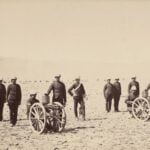
Image via All That’s Interesting
The Gatling Gun Was Invented to Save Lives — Then It Became a Tool of Crowd Control
Before the machine gun became a symbol of industrial-scale slaughter, it had a crank handle. All That’s Interesting revisits the Gatling gun, one of the world’s first rapid-fire weapons, first used during the Civil War and later turned on strikers and rioters as the 19th century gave way to the 20th. Mechanically, the Gatling gun is a bridge between eras: not the single-shot muskets of older wars, not yet the fully automatic guns of later ones, but something new and unsettling in between — a human-powered machine that multiplied firepower beyond what most people thought possible.
The piece traces how quickly that leap in capability migrated from battlefield experimentation to domestic enforcement. That trajectory is a recurring pattern in American history: innovations built for war rarely stay there. Once a government (or a private force) has access to a technology that can dominate space and intimidate crowds, it tends to appear wherever authorities feel threatened — not only by foreign armies, but by labor unrest, protests, and political instability at home.
Seen in historical context, the Gatling gun also helps explain a deeper shift: when weapons become faster, the relationship between the state and the public changes. The question stops being “Who has the better aim?” and becomes “Who controls the machine?” That’s as true in the crank-turned 1860s as it is in later debates about militarized policing and the tools carried into American streets.
Source: All That’s Interesting
Read the full story at All That’s Interesting →
That’s the capsule for today: a Revolution powered by immigrants, a New England city wearing an Atlantic memory, and a weapon whose legacy reminds us that technology never stays in the box we build for it.
— Time Capsule Editorial