In partnership with

Frontier models perform better in Attio’s agent harness.

We gave GPT-6 Astra the same job twice: analyze 100 sales calls and draft the follow-ups, once in Ask Attio and once in ChatGPT.
Ask Attio finished in 4 minutes 49 seconds. ChatGPT took 26 minutes 11 seconds, about 5.4 times as long.
The most ambitious GTM work requires more than frontier intelligence. It requires architecture that can put that intelligence to work at scale.

Three reminders that American history isn’t just what happened, but what we choose to preserve, polish, or forget.

Image via Smithsonian Magazine
The “Lost” Pages of the Dream Speech Were Hiding in Plain Sight
For years, the handwritten final draft of Martin Luther King Jr.’s “I Have a Dream” speech sat in that special category of American artifacts: famous enough to be mythologized, important enough to be hunted for, and elusive enough to be treated like it had vanished into history. Now we learn it wasn’t locked away in some secret archive or smuggled into a private collection overseas. It was reportedly sitting in a desk drawer for decades, the kind of quiet hiding place that feels almost too ordinary for words that helped move a nation.
What makes this discovery more than a collector’s thrill is what the pages show. Across seven sheets of yellow notepad paper, King is not carved in marble; he’s working. He crosses out lines, tests phrasing, and revises, reportedly the night before the March on Washington. It’s a window into the labor behind a moment we often treat as pure inspiration. The manuscript is expected to head to auction, which raises its own modern question: when a document belongs to the whole country’s memory, where should it live, and who should be able to see it?
There’s a deep historical echo here. The United States has repeatedly relied on chance, private decisions, and sheer luck to safeguard national treasures: family attics yielding wartime letters, courthouse basements holding forgotten records, and personal scrapbooks preserving movements that institutions ignored at the time. This find reminds us that history is not only made at microphones and marches. It’s also made in filing cabinets, desk drawers, and the everyday choices of what people keep.
Source: Smithsonian Magazine
Read the full story at Smithsonian Magazine →
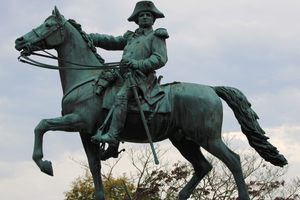
Image via Atlas Obscura
A Quiet Stone for “Old Put,” One of the Revolution’s Loudest Legends
Tucked in Brooklyn, Connecticut, the tombstone of General Israel Putnam offers a different kind of history lesson: not the booming battlefield story, but the afterlife of reputation. Putnam, known affectionately as “Old Put,” was a celebrated Patriot hero and a larger-than-life figure in Revolutionary-era lore. His name still carries the energy of the early republic, when Americans were building a national identity out of war stories, personal courage, and a hunger for homegrown legends.
Putnam’s fame was always part fact, part storytelling machine. The Revolution produced real leaders, but it also produced a public appetite for characters who could symbolize grit and independence. Putnam fit that need. Visiting a grave marker like this puts you in touch with how remembrance worked in an era before mass media as we know it: through monuments, oral traditions, local pride, and the slow settling of memory into stone.
And there’s something instructive about the setting itself. We often think historic importance must come with grand architecture and velvet ropes. But American history is full of modest sites that carried big meaning for the communities around them. A tombstone is a public statement about what a place chooses to honor. Standing in front of Putnam’s marker today, you’re not just looking at one man’s death date; you’re seeing how the Revolutionary generation and its descendants wanted the story told.
Source: Atlas Obscura
Read the full story at Atlas Obscura →

Image via All That’s Interesting
The Pilgrims We Celebrate vs. the Pilgrims Who Built Plymouth
Every November, the Pilgrims return to center stage in American storytelling, usually dressed in the soft-focus language of courage, faith, and communal gratitude. But the people who founded Plymouth Colony were far more complicated than the pageant version suggests. A new explainer revisits who they were and what they did, emphasizing details that tend to be trimmed away: ideological rigidity, harsh social control, and a willingness to use power in ways that harmed the most vulnerable, including Native communities.
This isn’t about swapping one cartoon for another. The point is that colonies were not simply small towns seeking freedom; they were political projects, built with rules, punishments, and ambitions. The Pilgrims were shaped by the turbulent religious and political conflicts of early modern Europe, and when they arrived, they carried those structures with them. Like many settler societies, Plymouth existed within a larger pattern: survival intertwined with expansion, alliances that could shift quickly, and cultural assumptions that justified unequal treatment.
The reason this matters now is that national holidays are not just days off; they are recurring lessons. When the story is simplified, we lose the chance to understand how a society forms its boundaries, decides who belongs, and explains violence to itself. The historical Pilgrims force a more honest question: what does it mean to build a community, and what costs did that building impose on others? History doesn’t take away gratitude, but it does demand accuracy.
Source: All That’s Interesting
Read the full story at All That’s Interesting →
That’s it for today’s Time Capsule. If you’re traveling for the holidays soon, keep an eye out for the small markers and overlooked documents in your own orbit. So often, the biggest stories are the ones sitting quietly where nobody thought to look.
— Time Capsule Editorial