Today’s Sponsor:
America's national debt has blown past $40 trillion — and we're adding another trillion every five months. Interest payments alone now top $1 trillion a year, meaning borrowed money is paying interest on borrowed money. Economists call this a debt death spiral, and your retirement savings could be caught in the middle.
A new free report reveals the three ways governments escape a debt spiral, how purchasing power quietly erodes, and exactly how to move a portion of your savings into a financial safe haven before it's too late. No cost. No obligation. Delivered to your inbox in minutes.
Get the Free Debt Death Spiral ReportThis is an advertisement from American Alternative Assets. If you no longer wish to receive these promotions, unsubscribe here. American Alternative Assets | 21700 W Oxnard St, Suite 850, Woodland Hills, CA 91367.

Three reminders that history is rarely as tidy as the version we memorized: rulers can change gender in the retelling, legends can leave a very real grave behind, and the land around modern cities keeps its oldest residents close to the surface.
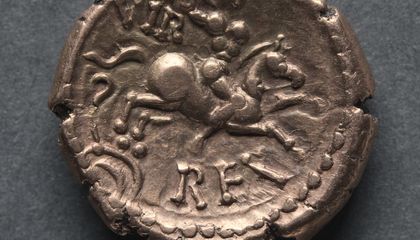
Image via Smithsonian Magazine
Was the British "King" Who Invited Rome Actually a Queen?
In the familiar telling of Rome’s conquest of Britain, one figure plays the role of a desperate client ruler: Verica, a leader who fled across the Channel and appealed to Emperor Claudius, helping set the stage for Rome’s invasion in A.D. 43. A new argument highlighted this week suggests that the story may be missing something basic and human: Verica may not have been a king at all, but a queen.
The case leans on the kind of evidence that often forces historians to squint: linguistic hints in names and titles, and the messages rulers stamped onto coins. In the ancient world, coins were not just currency; they were public relations, broadcast in metal. If an archaeologist can show that the language around Verica aligns more naturally with female rulership—or that Roman writers may have reshaped a local leader to fit their expectations—that would tell us as much about Roman storytelling as it does about Britain’s political landscape on the eve of conquest.
Source: Smithsonian Magazine
Read the full story at Smithsonian Magazine →
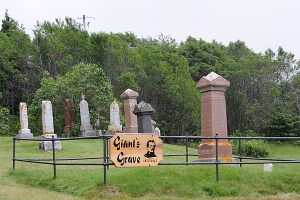
Image via Atlas Obscura
A Cape Breton Giant’s Quiet Marker in a Loud Age of Spectacle
In a small cemetery in Englishtown, Nova Scotia, there’s a grave that pulls modern visitors into a very old kind of question: where does a legend end and a life begin? Atlas Obscura spotlights the resting place of Angus MacAskill, remembered as the Giant MacAskill or the Cape Breton Giant—an outsized figure in both stature and reputation whose story has traveled far beyond his community.
MacAskill’s era was one that turned unusual bodies into public entertainment, with traveling shows and promoters eager to package “wonders” for paying crowds. That’s why a simple grave matters. It’s a reminder that behind the posters and the tall tales was a person rooted in a particular place, with neighbors, family, and the same final destination as everyone else. Cemeteries are like history’s anti-hype machine: they cut through the noise and insist, gently, on reality.
Source: Atlas Obscura
Read the full story at Atlas Obscura →
Near Paris, a Neolithic Cemetery Brings the First Farmers Back Into View
North of Paris, archaeologists have uncovered a cemetery dating back roughly 6,500 years, a discovery that adds intimate detail to a period we usually summarize in a sentence: the Neolithic, when farming communities reshaped Europe’s landscapes and lifeways. Finds like this don’t just tell us that people lived there—they show how a community handled death, memory, and belonging long before Paris was even a concept.
Burial grounds are among the most revealing archaeological sites because they preserve choices: where bodies were placed, what was left with them, and how space was organized over time. Across Neolithic Europe, cemeteries can hint at kinship, status, migration, and even conflict, but they can also speak to something quieter—how early settled communities created continuity, returning to the same ground generation after generation. In a region so often narrated through Roman roads and medieval cathedrals, a Neolithic cemetery is a reminder that “French history” starts far deeper than the usual timeline.
Source: Archaeology Magazine
Read the full story at Archaeology Magazine →
That’s the capsule for today. If you find yourself staring at a map, a grave marker, or an old coin this weekend, linger a moment—history has a habit of hiding its biggest stories in the smallest artifacts.
— Time Capsule Editorial