That "Trump Bump" Social Security raise? Already gone. Medicare premiums, gas, groceries — they've swallowed every penny before it hits your account. Meanwhile, your benefits have already lost 13.7% of their purchasing power since 2016, and the system would need to raise checks by 15.7% just to break even. You're getting $81. You needed $296.
Central banks have been quietly buying one specific asset at the fastest pace in 50 years — and JP Morgan now sees it hitting $8,000. Smart retirees aren't waiting on the next COLA. They're protecting what's left right now. Get the free guide and see the 3 steps disciplined retirees are using to outrun the inflation Washington can't stop.
Get the Free Wealth Preservation GuideThis is an advertisement from First Ballot. If you no longer wish to receive First Ballot promotionals, please let us know. Or write to: 5005 Lyndon B. Johnson Fwy. Suite 350, Dallas, TX 75244

A nor’easter may be revealing a 19th-century shipwreck off Cape Cod, a Victorian clock in Leeds turns time into theater, and Henry VII reminds us that power is rarely won once and kept forever without careful design.
/https://tf-cmsv2-smithsonianmag-media.s3.amazonaws.com/filer_public/74/af/74afbd73-0b7b-4181-b868-88e1e7bf6f15/8ff41a7a-5360-4471-81ba-786133bce5bc.jpg)
Image via Smithsonian Magazine
A Cape Cod nor’easter may be reintroducing us to an 1884 shipwreck
When a big coastal storm rearranges the shoreline, it can do more than knock out power lines and chew up dunes. It can also edit the archive. Along Cape Cod, the nor’easter lashing the East Coast may have uncovered timbers that could belong to the Warren Sawyer, a three-masted cargo schooner that ran aground in 1884 under gale-force winds. The sea that buried the story may now be briefly footnoting it in plain sight.
If the identification holds, it’s a vivid reminder of how busy and dangerous the 19th-century Atlantic coastline could be. Before radar, modern forecasting, and today’s navigation systems, a sudden shift in wind and waves could turn a routine run into a crisis in minutes. Cape Cod’s outer shore has long carried that reputation; it was nicknamed the Graveyard of the Atlantic for a reason. Wrecks were common enough that entire local economies and volunteer lifesaving crews grew up around the grim expectation that ships would, sooner or later, end up in the surf.
What’s especially time-capsule about moments like this is their fleetingness. Sand can preserve wood for decades and then, with one storm, expose it to sun, scavengers, and rot. That creates a scramble not just for curious beachgoers, but for historians and coastal managers who have to balance public interest with protection and documentation. A storm doesn’t just reveal artifacts; it sets a countdown clock on what survives.
Source: Smithsonian Magazine
Read the full story at Smithsonian Magazine →
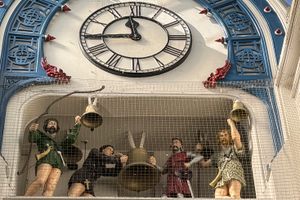
Image via Atlas Obscura
In a Leeds arcade, a clock turns Victorian timekeeping into a little pageant
At one end of Thornton’s Arcade in Leeds, beneath a graceful glass roof, an unusual cast of characters stands ready: figures from the world of Ivanhoe and English legend. When the hour arrives, they come to life in sequence — Robin Hood, Friar Tuck, Richard the Lionheart, and others — transforming an everyday glance at the time into a miniature performance. It’s the Ivanhoe Clock, and it’s a reminder that public timekeeping used to be as much spectacle as it was service.
That may sound quaint now, but it fits its moment perfectly. Victorian Britain was obsessed with synchronizing life: railways demanded standardized schedules, factories ran by the bell, and cities increasingly organized themselves around clocks that everyone could see and trust. At the same time, the era loved mechanical marvels. Animated clocks and automata weren’t just decorations; they were advertisements for modernity, engineering skill, and civic pride. If you could make time visible, audible, and entertaining, you could also make a statement about the place you lived and shopped.
And then there’s the storytelling choice. Ivanhoe-era characters embody a romantic, chivalric version of the English past that Victorians found deeply appealing — a kind of national costume drama set to gears and bells. Today, when our time is mostly personal and pocket-sized, the clock feels like a public reminder that communities once gathered around shared rhythms. Even if you’re just passing through the arcade, the show nudges you into a small, collective pause.
Source: Atlas Obscura
Read the full story at Atlas Obscura →

Image via HistoryExtra
Henry VII didn’t just win a crown — he engineered a reign
Henry VII often gets cast in popular memory as the careful, calculating starter of the Tudor story: more accountant than action hero, a king who hoarded cash and distrusted everybody. A reassessment of how he seized and kept the English crown argues that this reputation misses the real balancing act of his reign. After years of civil conflict in the Wars of the Roses, winning at Bosworth in 1485 was only the opening move. The harder problem was making that victory stick.
Henry’s situation was structurally fragile. His claim could be challenged, his support coalitions could shift, and the kingdom was exhausted by elite rivalries that had turned politics into armed contest. So he did what successful state-builders often do: he built legitimacy in layers. Military success mattered, but so did marriage alliances, careful management of nobles, tight control of finances, and an insistence on the symbols of lawful succession. Even small choices — how you handle would-be rivals, how you reward supporters without empowering them too much — can determine whether a new regime becomes a dynasty or a brief interlude.
The modern echo is less about crowns than about durability. We tend to treat power as something you acquire once: win the election, take the office, pass the bill. Henry VII’s story is a corrective. Stability is constructed day by day, and it requires an almost paradoxical mix of firmness and flexibility. In a time when many democracies and institutions feel stress-tested, it’s useful to remember that legitimacy isn’t only declared. It’s maintained.
Source: HistoryExtra
Read the full story at HistoryExtra →
That’s the capsule for today. If you find yourself near a beach after a storm or an old arcade at the top of the hour, linger a little — the past is often closest when we least expect it.
— Time Capsule Editorial