JP Morgan just quietly put a $8,000 price target on gold — and they don't publish numbers like this without ironclad data. Gold is already up roughly 80% since the start of 2025, hitting $5,500 while stocks, bonds, real estate, and Bitcoin all stumbled. Central banks now hold more gold than at any point since 1971, and gold has officially overtaken U.S. Treasuries as the world's #1 reserve asset — at the fastest pace in 50 years.
Most Americans are waiting for a pullback, waiting for confirmation, waiting for cable news to say it's safe — while the gap between those who moved first and those who waited keeps widening. You're making a decision today whether you realize it or not. Position before $8,000 prints, or scramble after every news anchor in America is already talking about it.
Get the Free Wealth Preservation GuideThis is an advertisement. If you no longer wish to receive promotional emails for this promotion, please unsubscribe here. Or write to: 5005 Lyndon B. Johnson Fwy. Suite 350, Dallas, TX 75244.

Three history puzzles for today: a Mediterranean meltdown with no single culprit, a pine that has watched five millennia pass, and a banker who helped invent the Renaissance while trying to outrun his conscience.
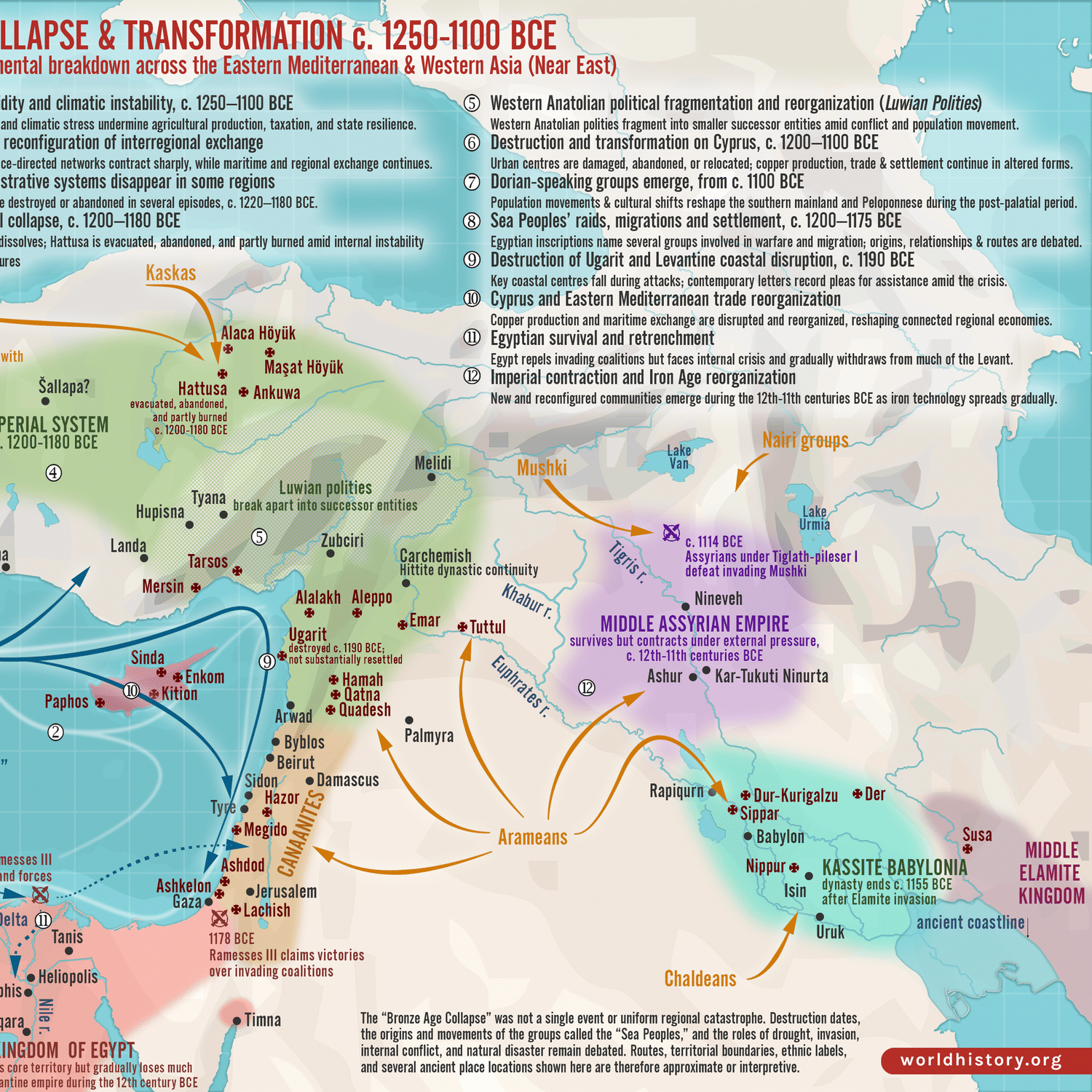
Image via World History Encyclopedia
The Bronze Age Collapse: When the Mediterranean’s "Global Economy" Fell Apart
We tend to imagine the ancient world as slow-moving and isolated, but the Late Bronze Age Mediterranean was anything but. Powerful kingdoms and city-states were tied together by long-distance trade, shared technologies, diplomatic marriages, and the constant movement of goods like copper and tin (the ingredients of bronze), grain, luxury textiles, and weapons. Then, around the 13th to 12th centuries BCE, that interconnected system began to fail. Major centers weakened or disappeared, palaces burned, trade routes broke, and writing systems went quiet in places that had relied on centralized record-keeping.
What makes the Bronze Age Collapse so haunting is how hard it is to pin on one villain. The record points to a cluster of pressures arriving at once: climate shifts and drought, internal political unrest, earthquakes in vulnerable regions, and violence from raids and migrations often associated with the enigmatic "Sea Peoples." When a society depends on far-flung supplies, specialized labor, and fragile political alliances, a few shocks can cascade into something bigger than anyone can manage. The collapse wasn’t a single night the lights went out across the Mediterranean; it was a slow, uneven unspooling that remade the region and set the stage for the Iron Age world that followed.
Source: World History Encyclopedia
Read the full story at World History Encyclopedia →

Image via All That’s Interesting
Methuselah the Bristlecone: A 5,000-Year Reminder That Time Moves Differently in the Mountains
In eastern California’s high, harsh country, a Great Basin bristlecone pine known as Methuselah has been alive for nearly 5,000 years. That means this single living organism took root before Stonehenge rose on the Salisbury Plain and before the Great Pyramid reached its finished form at Giza. It has outlasted empires, religions, languages, and borders—quietly adding growth rings one year at a time in a landscape where survival is earned, not given.
The bristlecone’s secret is almost counterintuitive: it thrives in conditions that seem inhospitable. Cold, wind, and thin soils slow everything down, including decay, and the tree’s dense, resinous wood resists pests and rot. In a way, Methuselah is a lesson in how longevity often comes from restraint rather than abundance. Its exact location is protected to prevent damage, which is its own modern historical footnote: we’ve learned, sometimes the hard way, that the rarest artifacts aren’t always in museums. Some of them are still alive.
Source: All That’s Interesting
Read the full story at All That’s Interesting →
Cosimo de’ Medici and the Renaissance: When Beauty Was Also a Business Strategy
We like our Renaissance origin stories clean: enlightened patrons, genius artists, and Florence as a bright beacon after the so-called darkness of the Middle Ages. The real history is more human, and more interesting. Cosimo de’ Medici, the great banker of 15th-century Florence, poured resources into art, architecture, libraries, and scholarship. But his patronage wasn’t just a refined hobby. It worked as politics, reputation management, and, importantly, spiritual accounting in an age when making money from money—usury—carried serious moral stigma.
Cosimo’s world treated the soul as something you could endanger through the wrong kind of profit, and salvation as something you could pursue through acts that benefited the community and the Church. Funding a chapel, commissioning sacred art, supporting monasteries, and bankrolling public works could function like moral ballast, even as the Medici bank expanded its power. Patronage also served as propaganda before the modern word existed: a way to associate the family name with piety, learning, and civic pride, so that wealth looked like destiny rather than extraction. The Renaissance, in this telling, isn’t diminished—it’s sharpened. You can admire the art and still notice the ledger books behind it.
Source: History Collection
Read the full story at History Collection →
That’s the capsule for today. If you’ve ever wondered what our own era will look like in hindsight, these three stories offer a hint: systems break, living things endure, and people have always used culture to explain themselves—sometimes to others, sometimes to their own conscience.
— Time Capsule Editorial