Policy is already moving markets in 2026 — trade enforcement, regulatory shifts, and tax positioning are redirecting capital right now. Institutions reposition before the headlines catch up, and the window to act early is closing fast.
Our analysts identified 5 stocks showing real momentum tied directly to current administration policy themes — including the sectors benefiting most from domestic investment trends and regulatory tailwinds. Don't get left behind.
Get the Free Report Now(By following any of the links above, you're choosing to opt in to receive insightful updates from The Investment News Daily + 2 free bonus subscriptions! Your privacy is important to us. You can unsubscribe anytime. See our privacy policy for details.)

Three reminders that history doesn’t stay neatly in museums. Sometimes it waits under berry bushes, rides on microscopic spores, or gets re-written by the people who inherit a building’s shadow.
/https://tf-cmsv2-smithsonianmag-media.s3.amazonaws.com/filer_public/4e/48/4e4842a1-490e-49d3-b0af-db0426c8b7e7/746589844_1340363594964410_3727259830028568757_n.jpeg)
Image via Smithsonian Magazine
In a Polish forest, a berry picker may have bumped into World War II’s unfinished business
A man foraging for berries in a forest in Poland may have stumbled onto something far heavier than a summer harvest: wreckage believed to be from an Allied aircraft lost during World War II. Investigators are still working to identify exactly what was found, but the early signs point toward an aviation relic that’s been quietly decomposing into the landscape for decades.
What makes this discovery especially intriguing is the local context. Experts note that an earlier find nearby included a piece of wing believed to belong to a British Lancaster bomber, one of the RAF’s most important heavy bombers of the war. Poland’s forests have long served as accidental archives of the 20th century, holding onto crashed planes, scattered equipment, and sometimes even the traces of the people involved. When an aircraft goes down, it doesn’t just vanish; it becomes part of the soil’s memory.
There’s also a bigger historical echo here: the air war over Europe was not only fought in the skies, but absorbed by the countryside below. Many crews never made it home, and many crash sites were never fully documented in the chaos of wartime and the geopolitical reshuffling that followed. A find like this can become a small act of repair, reconnecting names, missions, and families to a spot on the map.
Source: Smithsonian Magazine
Read the full story at Smithsonian Magazine →

Image via Popular Mechanics
The king’s tomb that punished curiosity: when archaeology meets a living hazard
In the 1970s, archaeologists opened the 500-year-old tomb of Poland’s King Casimir IV Jagiellon, expecting the usual challenges of a major excavation: delicate artifacts, unstable materials, the careful choreography of documenting the past without destroying it. What they didn’t anticipate was a delayed body count. In the years after the unsealing, 15 people connected to the work reportedly died, and the investigation into why became one of the most unsettling intersections of history, biology, and occupational risk.
The culprit wasn’t a pharaoh’s curse, but something more ordinary and more unnerving: microscopic fungus. Popular accounts often flatten these stories into spooky warnings, but the underlying reality is both practical and humbling. Sealed spaces can preserve not only textiles and wood, but also mold and spores that remain dangerous when suddenly released into fresh air and human lungs. The organism linked to the tomb is still present in our world today, a reminder that “ancient” does not always mean “inactive.”
This is a very modern lesson hiding inside an old stone chamber: the past can harm you in ways that have nothing to do with superstition. It’s also a case study in how archaeology has evolved. Protective gear, air testing, and biohazard awareness are now part of many excavation plans precisely because of incidents like this. Sometimes the most enduring thing inside a tomb isn’t gold or bones, but a living ecosystem that has been waiting centuries for a door to open.
Source: Popular Mechanics
Read the full story at Popular Mechanics →
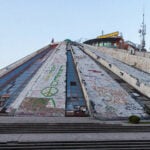
Image via All That’s Interesting
Tirana’s Pyramid: built for a dictator, re-claimed by a generation that outlived him
In the late communist era, Albania built a striking pyramid-shaped monument in Tirana to honor Enver Hoxha, the country’s longtime dictator. It was meant to fix his legacy in concrete and geometry, the kind of building that tries to tell citizens: this story is settled, this memory is permanent. But history has a habit of refusing the captions we assign it.
After communism collapsed, the Pyramid of Tirana became something far messier and more interesting than a shrine. It cycled through uses and reputations, at times neglected and debated, and eventually was reimagined and reclaimed, especially by young Albanians who treated it less like a sacred object and more like an urban canvas. A structure designed to enforce a single narrative became a place where new ones could be tried out, argued over, and lived.
There’s a familiar pattern here for anyone watching how countries deal with contested monuments. Buildings don’t just reflect power; they also become arenas where power gets renegotiated. The Pyramid’s story isn’t simply about preserving or erasing the past. It’s about what happens when a community decides that the most honest response to a heavy inheritance is neither worship nor demolition, but transformation.
Source: All That’s Interesting
Read the full story at All That’s Interesting →
That’s the capsule for today. If you spot a place in your town that seems ordinary but feels older than it looks, follow that feeling gently. History loves to hide in plain sight.
— Time Capsule Editorial